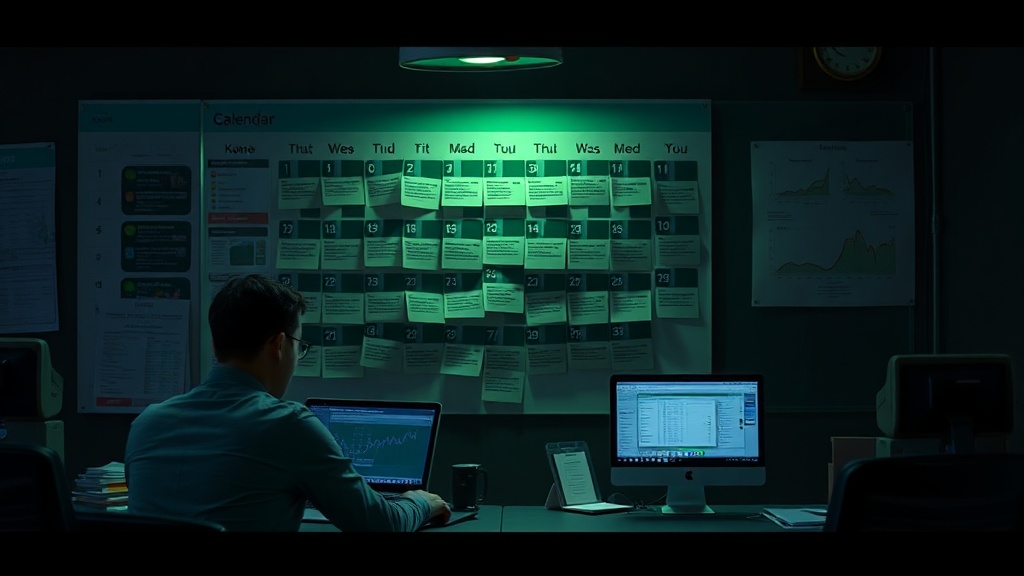
Why Your Calendar Looks Full But Your Output Stays Flat

In this post, you'll learn why packed calendars often hide shallow work patterns — and how to reclaim your schedule for meaningful output without adding hours to your day. If you've ever ended a busy week wondering what you actually accomplished, this is for you.
What Makes a Calendar "Full" vs. Actually Productive?
Most professionals treat a packed calendar as a badge of honor. Color-coded blocks stretching from 9 AM to 6 PM. Back-to-back meetings with five-minute breathing room. Lunch scheduled at your desk between calls. It looks like you're crushing it.
But here's the uncomfortable truth — a full calendar and meaningful output are two different things. Research from the Asana Anatomy of Work report found that knowledge workers spend 58% of their day on "work about work" — status updates, searching for information, and managing shifting priorities — rather than the skilled work they were hired to do.
The difference lies in what fills those blocks. A calendar stuffed with reactive tasks (meetings, email responses, quick check-ins) creates the feeling of productivity without the results. Real output — the kind that moves projects forward and builds your reputation — requires uninterrupted blocks of focused time. And those rarely survive a calendar that treats every incoming request as equally urgent.
How Do Back-to-Back Meetings Kill Deep Work?
Context switching isn't just annoying — it's expensive. Studies from the American Psychological Association show that shifting between tasks can cost as much as 40% of productive time. When your calendar alternates between a strategy session, a client call, and a team sync every hour, your brain never settles into the flow state where real work happens.
Deep work — the term popularized by Cal Newport — requires sustained attention on cognitively demanding tasks. Most knowledge work benefits from 90-minute to 2-hour uninterrupted stretches. Yet the average professional's calendar fragments their day into 30- to 60-minute chunks, leaving just enough time to start something meaningful before the next interruption.
The result? You spend your "busy" hours in shallow work mode — answering emails, attending status meetings, reacting to Slack pings. The important projects (the ones that actually advance your career or business) get pushed to evenings and weekends. Or worse, they stagnate indefinitely while your calendar stays impressively full.
Why Do We Keep Saying Yes to Calendar Clutter?
Part of the problem is social pressure. In many organizations, an empty calendar signals availability — which gets interpreted as underutilization. Nobody wants to be the person with "nothing to do." So we accept meeting invites reflexively, volunteer for committees we don't care about, and agree to "quick syncs" that stretch to 45 minutes.
There's also the planning fallacy — our tendency to underestimate how long tasks take. When you block 30 minutes for "review project brief," you're probably imagining the ideal version where nothing goes wrong. Reality includes Slack interruptions, urgent emails, and the mental drag of knowing your next meeting starts in 20 minutes. The work expands to fill the anxiety, and you end the day with a checked-off calendar but an unchecked to-do list.
Finally, there's the immediacy bias. Urgent feels important, even when it isn't. A meeting happening now always beats work due next week — until next week arrives and you're scrambling.
What Does a High-Output Calendar Actually Look Like?
Professionals who ship meaningful work protect their time aggressively. Their calendars don't look sparse — they look intentional. Here's what that means in practice:
Protected deep work blocks. These aren't "free time" — they're scheduled commitments to specific projects. Treat them like client meetings: non-negotiable, with clear objectives. If someone tries to book over them, you decline or propose an alternative.
Meeting-free zones. Whether it's mornings, afternoons, or specific days (the famous "no-meeting Wednesday"), high-performers create predictable space for focused work. Companies like Twitter and Shopify have experimented with company-wide meeting-free days, reporting significant boosts in output and employee satisfaction.
Batch processing. Instead of scattering email and administrative tasks throughout the day, cluster them into defined windows. Check messages at 10 AM, 1 PM, and 4 PM — not continuously. Your brain stays in execution mode longer, and you stop living in reactive triage.
Intentional buffers. Back-to-back meetings guarantee you'll run late and arrive frazzled. Build 15-minute buffers between commitments for note-taking, mental reset, and actual preparation. The meeting that follows will be more productive because you showed up ready.
How Can You Audit Your Calendar for Real Productivity?
Before you can fix your schedule, you need to see it clearly. Try this: color-code your calendar retroactively for one week. Use three categories — deep work (focused project time), shallow work (meetings, email, administrative tasks), and reactive work (urgent interruptions, unplanned requests).
Most people are shocked by the ratio. If shallow and reactive work consume 70% or more of your time, you're not alone — but you're also not doing your best work. The goal isn't zero meetings (collaboration matters) but intentional meetings. Every recurring meeting should earn its place. If it doesn't have a clear agenda, decision-maker, and intended outcome, cancel it or convert it to async communication.
Next, identify your biological prime time — the hours when you naturally focus best. For many people, this is morning. For night owls, it's afternoon or evening. Protect these hours for your hardest cognitive work. Schedule meetings, email, and administrative tasks during your energy valleys.
What Happens When You Actually Defend Your Time?
The first few weeks feel uncomfortable. Colleagues might push back. You'll worry about appearing unresponsive or unavailable. But something shifts around week three — you start finishing projects that have been stuck for months. Your work quality improves because you're thinking deeply instead of frantically. You leave the office (or close the laptop) with a sense of completion rather than perpetual behind-ness.
Your calendar might look emptier to others. But the output you produce — the shipped projects, the solved problems, the strategic thinking you finally have space for — tells a different story. Busy isn't the goal. Results are.
Start small. Block two hours tomorrow morning for your most important project. Decline one meeting that doesn't require you. Notice what happens when you stop treating your calendar as a public reservation system and start treating it as a tool for focused work. The difference might surprise you.